
What Are the Differences Between FUE and FUT Hair Transplants?
25 Jun 2026Introduction
One of the most common aesthetic issues impacting both men and women nowadays is hair loss. Hair transplantation has emerged as a reliable and long-term option for restoring natural hair growth due to growing understanding of and accessibility to medical aesthetics. More people are actively looking for expert treatments in locations like Bangalore, where early hair thinning is caused by environmental factors, genetics, and lifestyle stress.
Choosing between the two most popular methods, FUT (Follicular Unit Transplantation) and FUE (Follicular Unit Extraction), is one of the most frequently asked queries patients have. Although both are popular and successful hair restoration procedures, they vary in terms of method, recovery, scarring, and suitability.
Prior to choosing a hair transplant process, it is important to fully understand these differences. Patients can select the best approach based on their expectations, donor availability, and hair loss pattern under the guidance of an experienced hair specialist doctor in Bangalore like Dr. Ashok BC.
This blog helps you make an informed choice by providing a detailed explanation of both processes.
What Is Hair Transplantation?
A minimally invasive surgical technique called hair transplantation is used to restore hair in bald or thinning areas. It involves transferring healthy hair follicles from a donor area, typically the sides or back of the scalp, to places that are losing hair.
Since the transplanted hair is genetically resistant to balding, this surgery appears to be a very successful method of hair restoration. These follicles grow naturally for the rest of their lives after being implanted.
When carried out correctly by a trained specialist, modern hair transplantation techniques guarantee improved hairline design, natural-looking density, and long-term results.
To put it simply, hair transplantation aims to restore confidence, appearances and self-esteem in addition to hair.
Understanding the Two Main Hair Transplant Procedures
There are two globally recognized gold-standard methods in hair transplant procedure techniques:
- FUE (Follicular Unit Extraction)
- FUT (Follicular Unit Transplantation)
Both methods aim to achieve the same result - natural hair regrowth - but differ in how the donor hair is extracted and transplanted. The choice between them depends on individual hair loss severity, scalp condition, and long-term goals.
Let's understand each technique in detail.
What Is FUE Hair Transplant?
Procedure Explanation
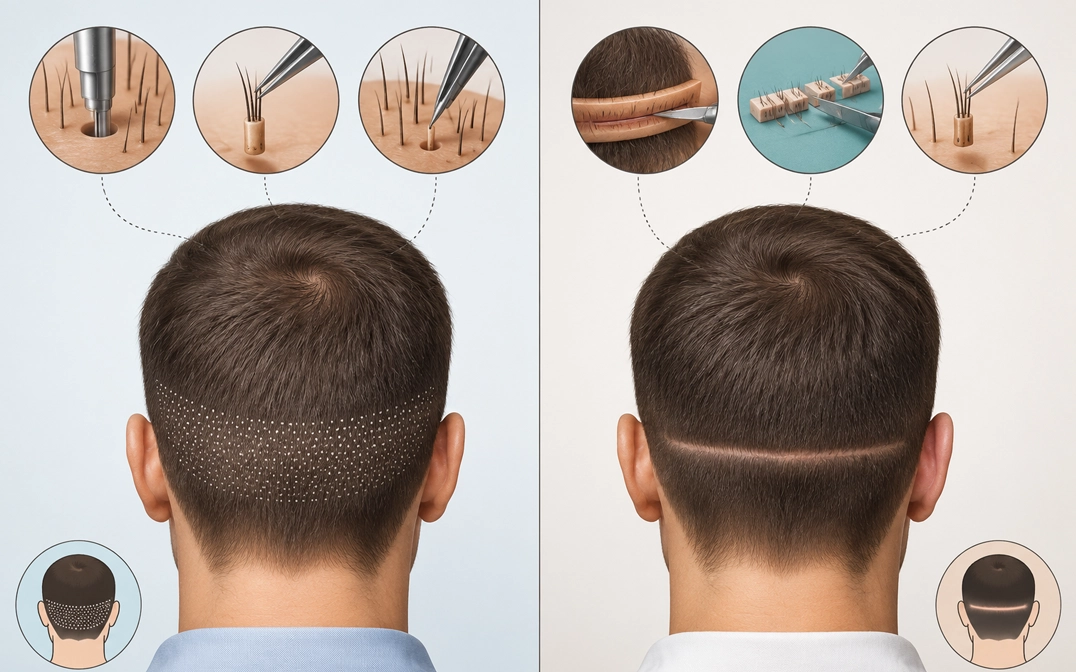
FUE, or Follicular Unit Extraction, is a modern and minimally invasive technique where individual hair follicles are extracted directly from the donor area using a micro-punch tool.
Each follicular unit is carefully removed and implanted into the thinning or bald areas. Since follicles are extracted one by one, there is no need for stitches or linear incisions.
This makes FUE one of the most advanced forms of hair transplantation, offering precision and natural results.
Advantages of FUE
FUE has become highly popular due to its patient-friendly approach:
- Minimal visible scarring (tiny dot scars that are hardly noticeable)
- Faster recovery time compared to traditional methods
- Suitable for short hairstyles due to lack of linear scar
- Less post-operative discomfort and downtime
- Natural-looking hairline design when performed by experts
Limitations of FUE
Despite its benefits, FUE has certain limitations:
- The procedure is time-consuming, especially for large graft requirements
- Requires high surgical expertise and precision
- May be more expensive due to labor-intensive extraction
What Is FUT Hair Transplant?
Procedure Explanation
FUT, or Follicular Unit Transplantation, is a traditional but still widely used hair transplant procedure. In this method, a thin strip of scalp is surgically removed from the donor area, usually the back of the head.
The strip is then dissected under a microscope into individual follicular units, which are implanted into balding regions.
This method allows transplantation of a large number of grafts in a single session, making it effective for extensive hair loss cases.
Advantages of FUT
FUT offers several clinical advantages:
- Higher number of grafts can be transplanted in one session
- More cost-effective compared to FUE in many cases
- Suitable for patients with advanced baldness requiring dense coverage
Limitations of FUT
However, FUT also comes with certain drawbacks:
- Leaves a linear scar in the donor area
- Longer healing and recovery period
- Slight discomfort or tightness after surgery
- Not ideal for patients who prefer very short hairstyles
Understand FUT method for effective hair restoration choice
Book Hair ConsultationFUE vs FUT - Key Differences Explained
Understanding the difference between FUE and FUT is crucial before selecting the right hair restoration treatment.
| Factor | FUE (Follicular Unit Extraction) | FUT (Follicular Unit Transplantation) |
|---|---|---|
| Surgical Technique | Individual follicle extraction using micro-punch tools | A strip of scalp is removed and dissected into grafts |
| Scarring | Tiny dot-like scars, usually not visible | Linear scar in the donor area |
| Recovery Time | Faster recovery with minimal downtime | Longer recovery due to sutures and healing incision |
| Suitability | Ideal for early to moderate hair loss | Better for advanced hair loss requiring a high graft count |
| Cost Differences | Generally more expensive due to time and precision involved | Relatively more cost-effective for larger sessions |
| Results & Density | Both techniques can deliver natural-looking results when performed correctly; outcomes depend heavily on surgical expertise | Both techniques can deliver natural-looking results when performed correctly; outcomes depend heavily on surgical expertise |
Which Hair Transplant Procedure Is Right for You?
Choosing between FUE and FUT is not a one-size-fits-all decision. The right choice depends on several factors:
- Age and stage of hair loss
- Extent of baldness
- Donor area density and strength
- Lifestyle preferences (hairstyle choices, recovery time tolerance)
A proper evaluation by a qualified hair specialist doctor in Bangalore is essential before deciding on any hair transplantation method.
At this stage, expert guidance ensures that patients receive a customized treatment plan that aligns with both medical suitability and aesthetic expectations.
Role of a Hair Specialist Doctor in Bangalore
The success of a hair transplant procedure depends significantly on the expertise of the surgeon. A skilled hair specialist doctor in Bangalore plays a crucial role in:
- Diagnosing the exact cause and pattern of hair loss
- Evaluating donor hair quality and density
- Recommending the most suitable technique (FUE or FUT)
- Designing a natural hairline for balanced facial aesthetics
- Ensuring safe and effective hair restoration treatment
Dr Ashok BC follows a patient-centric approach where every case is carefully assessed before deciding the surgical plan. The focus remains on achieving natural-looking, long-lasting results with minimal risk and high precision.
Hair Transplant Procedure - What to Expect?
Pre-Procedure Evaluation
Before surgery, the doctor performs a detailed scalp analysis and reviews medical history to ensure suitability for hair transplantation.
During the Procedure
- Local anesthesia is administered for comfort
- Hair follicles are extracted using FUE or FUT technique
- Grafts are implanted into the recipient areas with precision
Post-Procedure Care
- Mild swelling or redness may occur initially
- Shedding of transplanted hair is normal in the first few weeks
- New hair growth typically begins within 3-4 months
- Full results appear between 9-12 months
Common Myths About Hair Transplantation
Myth 1: Hair transplants look unnatural
Modern techniques ensure natural density and hairline design when done by experts.
Myth 2: Only men need hair transplantation
Women also undergo hair restoration treatment for thinning and pattern hair loss.
Myth 3: Results are immediate
Hair growth is gradual and takes several months.
Myth 4: The procedure is very painful
With local anesthesia, the hair transplant procedure is generally comfortable.
Benefits of Modern Hair Restoration Treatment
Advancements in hair restoration treatment have made procedures safer and more effective:
- Permanent solution for genetically resistant hair loss
- Natural hairline design tailored to facial structure
- Improved confidence and self-image
- Minimally invasive techniques with better recovery
- Long-term cost-effective compared to temporary solutions
Conclusion
Both FUE and FUT are proven and effective methods of hair transplantation, but they differ significantly in technique, recovery, and suitability. While FUE offers minimal scarring and faster healing, FUT allows higher graft extraction in a single session.
The right choice depends on individual hair loss patterns, donor availability, and lifestyle preferences. This is why consultation with an experienced hair specialist doctor in Bangalore is essential before deciding on any hair transplant procedure.
With proper evaluation and expert guidance, patients can achieve natural, long-lasting results through the most suitable form of hair restoration treatment, restoring not just hair—but confidence and quality of life.
Restore confidence with the right hair restoration treatment choice
Schedule an AppointmentFAQ
Is hair transplantation permanent?
Yes, transplanted hair is typically permanent because it is taken from genetically resistant donor areas and continues to grow naturally.
How long does a hair transplant procedure take?
It usually takes between 4 to 8 hours depending on the number of grafts and technique used.
Is FUE better than FUT?
Both are effective. FUE is less invasive, while FUT is suitable for higher graft requirements. The choice depends on individual needs.
When will I see results after hair restoration treatment?
Initial growth begins in 3 to 4 months, with full results visible between 9–12 months.
Can women undergo hair transplantation?
Yes, women with stable donor areas and suitable hair loss patterns can undergo hair transplantation safely.